
By Ryan Sandford-Blackburn
On 22 June evening, I attended the inaugural Transition Belper Zero Waste Business awards. We won an award!
The Zero Waste group came about after Transition Belper’s ‘Community Conversation’ event in October 2021. After consultation with local shop owners, the group found there was scope to help local businesses reduce their environmental impact.
Oh what a night

The organisers did a good thing by bringing people together. They fed us too, with food prepared and served by Reunion Deli.
My plus one was my 4 year old son. He’s been there since the start, alongside me in Earthed Up! gardens. He earned his sausage roll and brownie with ice cream! Plus, Thursday evenings are a tricky time for people to make, all our members have caring commitments.
What stood out was how vital Belper’s community is. Without people’s support there wouldn’t be all of these ecologically minded, “sustainable” businesses. “Use it or lose it” was a strong sentiment from some of the business owners.
If you’re buying food, clothes, books, homewares, or gifts, central Belper has very good options!
This award is dedicated to our customers, who are helping reduce waste by growing their own food!
Produce no waste
David Holmgren’s permaculture principles help us design like Nature. One of those principles is Produce no waste; it’s written like an instruction, thou shalt… Now, in ecological systems there’s no such thing as waste. Everything is connected. It’s through human’s disconnect with natural processes that yields are lost or consciously exported. Sent to The Land of Away.
It was through careful consideration from the off that we don’t produce much material waste.
Our biggest perceived waste could well be time. Through doing things differently – cooperatively and ecologically – there’s researching, trialing, errors. We’ve not wasted time though, we’ve invested in learning, from our mistakes.
How can a plant nursery be wasteful?
We work in the garden, hands in the soil, that kind of stuff. Yes and the horticulture industry is wasteful. Trays, pots, labels, packaging and so on. This one commercial nursery company states, “In 2018, our company reported a total recovery obligation of 348 tonnes, broken down into four tonnes of paper, 116 tonnes of plastic and 92 tonnes of wood.” The mind boggles.
Plastic
- We grow all our own plants, not buying anything in. Bought in plants come packaged, wrapped for transport, then typically potted on from their plastic trays.
- When pricking out/potting on, many plants have gone into the ground in coldframes this year, rather than in pots.
- All plant pots we use are second hand and/or recyclable.
- The module trays we propagate in are durable hard plastic, intended to be used for 15 years or hopefully more.
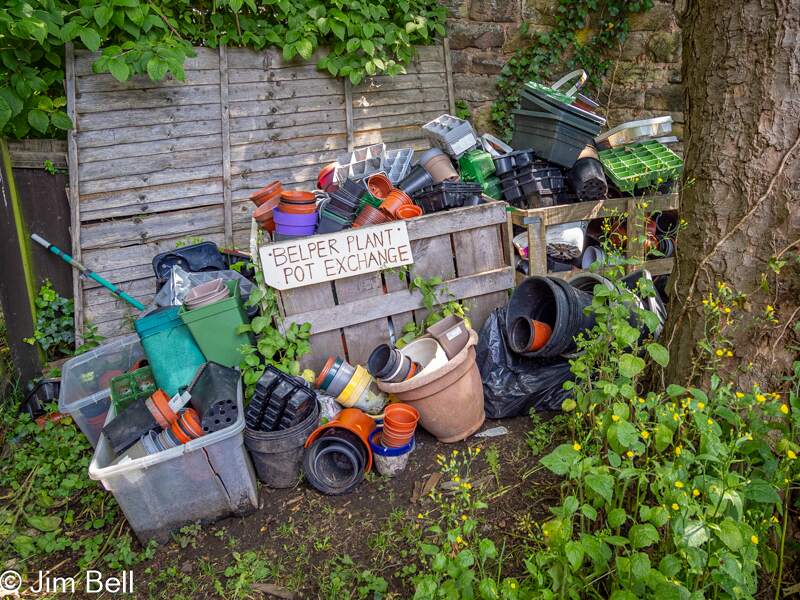
- We set up the plant pot exchange at Belper Community Hall – take your surplus pots there and take away what you’d like. It’s well used but there’s more plant pots in the world than is necessary, Belper is no exception.
Wood
We try very hard not to buy new timber and if we do we try to get seconds. Mostly, we scavenge and reuse.
Applications
I won’t get deep into the less obvious horticulture waste of chemical fertilisers, insecticides, fungicides, and peat. They weren’t factors in this award’s criteria but are also considerations in horticulture. (We don’t use any of those things). We have, however used 3600l of mains water over 2 years. Next year, it should be none.
Our targets
Currently, all that goes in the refuse bin is scraps found in gardens, like old wrappers, plastic twine, broken glass, broken pots. Any consumables are composted or recycled. We aren’t perfect and we are improving.
Plastic bags from compost

We don’t buy new plastic, we’d like to use even less plastic altogether. The main area to do this is in bagged compost.
We save all of our used compost sacks and use them to haul woodchip or manure, or to crush char in or…you know, useful stuff. We’re going to repurpose some as packaging for biochar.
We need to work on the Reduce bit as a priority. The first year of growing, our potting media was just out the bag. Now, 5% of our potting mix is own made vermicompost, 20% is biochar sourced locally. So, a quarter less imported bagged compost. Can we reduce that further? Let’s see.
We are going to help reduce your plastic use by offering peat free compost refills by Spring 2024. Bring a container to our Belper Lane End garden and fill it with quality compost! Details to be announced once we have it.
We will continue to share knowledge to help you make your own compost too. Join us in September for the next course.
If you have any questions about how we grow, please get in touch, come visit and we’ll show you the nitty gritty.
 Earthed Up!